








Recent Public Posts - [guest]
| BTP Officers referred to to Watchdog over Levy case In "The Wider Picture in the United Kingdom" [378542/32394/51] Posted by TaplowGreen at 08:23, 22nd August 2026 |      |
Catalogue of errors with awful consequences.
https://www.bbc.co.uk/news/articles/cn4n55g2dejo
| Re: Cornish mainline and branch line delays - ongoing discussion In "Shorter journeys in Plymouth and Cornwall" [378541/28556/25] Posted by TaplowGreen at 08:06, 22nd August 2026 | |
Cancellations to services between Truro and Falmouth Docks
Due to more trains than usual needing repairs at the same time between Truro and Falmouth Docks fewer trains are able to run.
Train services running to and from these stations may be cancelled. Disruption is expected until the end of the day.
Customer Advice
-
What has happened?
-
One of the trains that operates the Truro to Falmouth Docks service has developed a fault that needs mechanical attention. We do have another train that is operating the service, which means we can only operate half of the service for the rest of today.
If you are wanting to travel to Falmouth, please check your journey and if there is not a service, we recommend take a local bus, where your ticket can be used at no extra cost.
Due to more trains than usual needing repairs at the same time between Truro and Falmouth Docks fewer trains are able to run.
Train services running to and from these stations may be cancelled. Disruption is expected until the end of the day.
Customer Advice
-
What has happened?
-
One of the trains that operates the Truro to Falmouth Docks service has developed a fault that needs mechanical attention. We do have another train that is operating the service, which means we can only operate half of the service for the rest of today.
If you are wanting to travel to Falmouth, please check your journey and if there is not a service, we recommend take a local bus, where your ticket can be used at no extra cost.
Same again today......
Cancellations to services between Truro and Falmouth Docks
Due to more trains than usual needing repairs at the same time between Truro and Falmouth Docks fewer trains are able to run.
Train services running to and from these stations may be cancelled. Disruption is expected until the end of the day.
.......one of the options on offer is "Consider postponing your journey until our service returns to normal" - extremely helpful - if anyone has a crystal ball handy!
| Re: NPPF revisions - more homes can be built near stations? In "Looking forward - the next 2, 5, 10 and 20 years" [378540/32385/40] Posted by REVUpminster at 07:27, 22nd August 2026 | |
Torbay Council have proposals to develop Paignton Station and car park, the short term car park opposite, and the bus station into flats. A new multi-story car park would be built out of site behind the library in Station Lane. The are plans for flats at Victoria Square within a stones throw of the station and is a temporary car park now.
I've also thought housing could be developed at Yeoford. Trains every half an hour, roads are terrible. It would need track infrastructure improvements which GWR wouldn't do unless someone else pays. Maybe the new GBR would?
| Re: Espresso - undiluted monthly compendia In "News, Help and Assistance" [378539/22974/29] Posted by grahame at 05:10, 22nd August 2026 | |
After being quietly suspended for a while during a denial of service attack, I am re-enabling the espresso facility. I have also automate the default so that it becomes month-to-date without me having to go in and change it manually at the start of each month; I still have to remember on 1st January each year to update the year!
This is not a facility that gets huge use, nor would I expect it to be - but if you want to find out what we were talking about in (say) March 2012, it will help.
Espresso now has an https wrapper which will help ensure that members don't get lots of security warnings in their browser when they use it, and may also help our search engine and AI feed visibility. I will be keeping an eye open just in case it generates significant server loads. And I will be adding back the facility to navigate around it better too.
| Re: NPPF revisions - more homes can be built near stations? In "Looking forward - the next 2, 5, 10 and 20 years" [378537/32385/40] Posted by grahame at 04:48, 22nd August 2026 | |
Houses without requiring planning consent
They'd still need planning consent in consideration of other issues, would they not, as the following extract from NPPF says:
These should be approved, unless the benefits of doing so would be substantially outweighed by any adverse effects, when assessed against the national decision-making policies in this Framework
The NPPF is, I think, trying to say: "Developments outside settlement boundaries are usually a bad thing, but if there's a useful railway station nearby, we can say that the development is actually OK".
What I'm having trouble in deciding is whether or not the "Top 80 GVA" rule is actually doing anything useful.
I would agree.
With (any) development there will be positive and negative factors and planning discussions result not in a "100% yes" or "100% no" agreed outcome. The various elements of the NPPF we're talking about help swing some of the factors - give extra weight to some of the elements and perhaps substantial weight that makes a difference in some cases.
I see that the Conservative-elected, Reform-representing MP for Bedwyn and Pewsey is making the local press concerning the NPPF for those two stations and the Wiltshire Gazette article has a picture of an IET at a rural-looking Bedwyn station. But then as I read the maps, Bedwyn is just outside a top 80 area. Those are potentially an interesting watch from the sidelines.
Across the South West, most of our MPs represent parties who are not part of the government - Conservative, Liberal Democrat, Reform and Green - and they have the luxury of being able to represent their electorate without facing the hard national consequences where difficult choices which are in the country's intrerest but not in the interest of the views of their electorate, and you might expect pushback from a wide variety of places. As I understand it, these "station rules" are only one element, and factors like building on flood plains (and railways tend to follow rivers) are still significant to put it mildly.
The "Top 80" rule does help exclude places like Lelant Saltings - there might a station there, it might be practical to stop 2 trains an hour each way, and there might be unused close to the station - but the question to be asked is "travel to WHAT work?"
| Re: Melksham to Bristol Parkway - no fare, mis-advertised, mis-sold, not corrected In "Fare's Fair" [378536/32392/4] Posted by grahame at 04:16, 22nd August 2026 | |
Which route is shorter?
Journey time shorter - via Swindon.
Normally least changes on scheduled passenger trains - via Swindon (1 change)
Physical distance shorter - via Thingley Junction and the Rhubarb Loop
https://my.railmiles.me/mileage-engine/
Distance:
31mi 0ch
Route:
Melksham, Thingley Jn, Bathampton Jn, Bath Spa, Oldfield Park, Twerton, Keynsham, North Somerset Jn, Dr Day's Jn, Lawrence Hill, Stapleton Road, Narroways Hill Jn, Ashley Down, Horfield Junction, Filton Abbey Wood, Filton Jn, Bristol Parkway
31mi 0ch
Route:
Melksham, Thingley Jn, Bathampton Jn, Bath Spa, Oldfield Park, Twerton, Keynsham, North Somerset Jn, Dr Day's Jn, Lawrence Hill, Stapleton Road, Narroways Hill Jn, Ashley Down, Horfield Junction, Filton Abbey Wood, Filton Jn, Bristol Parkway
or add these who
Distance:
22mi 70ch
Route:
Melksham, Thingley Jn, Thingley East Junction, Chippenham, Dauntsey, Wootton Bassett Jn, Rushey Platt, Swindon
plus
Distance:
34mi 39ch
Route:
Swindon, Rushey Platt, Wootton Bassett Jn, Little Somerford, Hullavington, Badminton, Chipping Sodbury, Westerleigh Jn, Bristol Parkway
and subtract 2 x Wooton Bassett to Swindon
Distance:
5mi 49ch
Route:
Wootton Bassett Jn, Rushey Platt, Swindon
22mi 70ch
Route:
Melksham, Thingley Jn, Thingley East Junction, Chippenham, Dauntsey, Wootton Bassett Jn, Rushey Platt, Swindon
plus
Distance:
34mi 39ch
Route:
Swindon, Rushey Platt, Wootton Bassett Jn, Little Somerford, Hullavington, Badminton, Chipping Sodbury, Westerleigh Jn, Bristol Parkway
and subtract 2 x Wooton Bassett to Swindon
Distance:
5mi 49ch
Route:
Wootton Bassett Jn, Rushey Platt, Swindon
| Re: What might have been - Westbury to Brussels and Swindon to Paris In "Campaigns for new and improved services" [378535/27805/28] Posted by grahame at 03:34, 22nd August 2026 | |
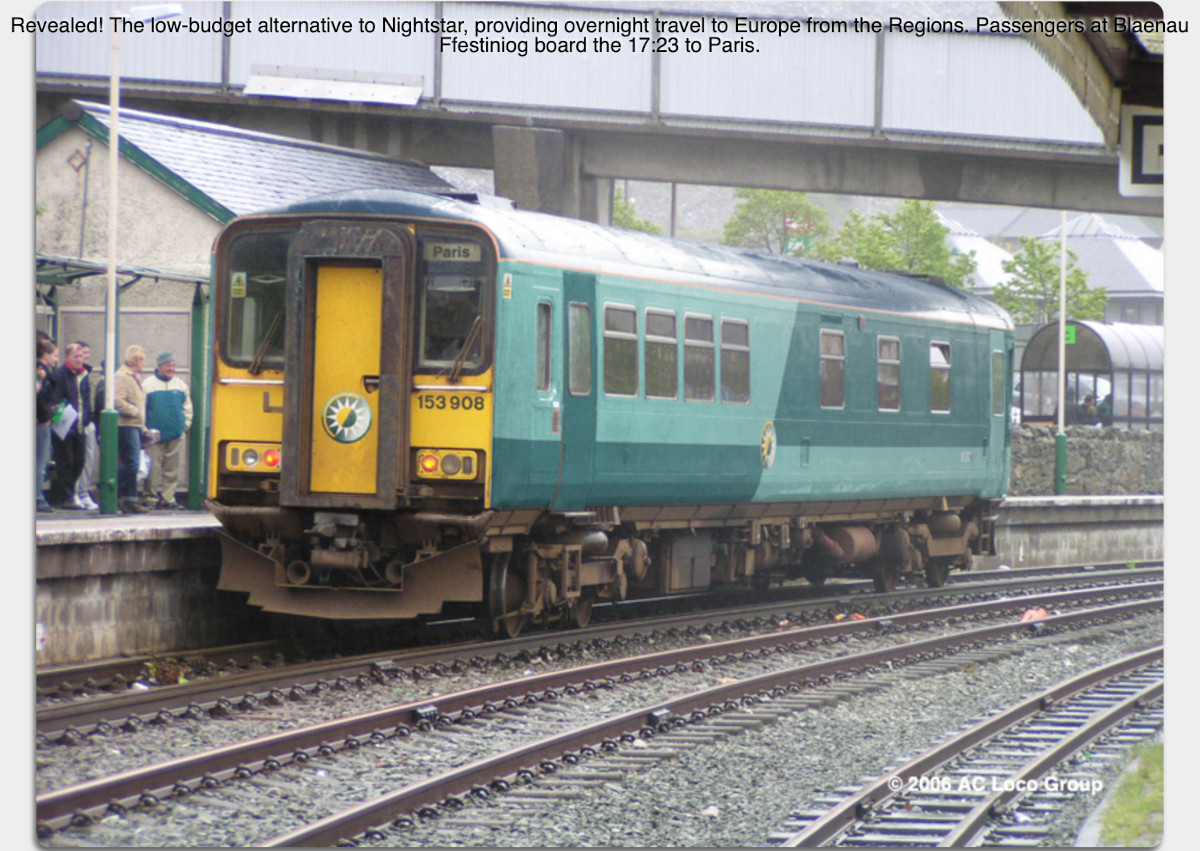
The "trains is other liveries" website had a photoshopped picture of a 153 at Blaenau Ffestiniog in Nightstar livery and one wonders what traffic from there to the other end of the route - perhaps Venlo - might have been ... but yet ...
http://25kv.uk/fictitiousliveries.php
| Re: Wilts & Berks Canal - merged posts, ongoing developments and discussion In "Heritage railways, Railtours, buses, canals, steamships and other public transport based attractions" [378534/28863/47] Posted by grahame at 03:29, 22nd August 2026 | |
**J. F. Pownall has entered the chat**
https://www.nature.com/articles/149467a0
Abstract
IN a booklet entitled “The Projected Grand Contour Canal” (Birmingham: Cotterell and Co., 2s.), Mr. J. F. Pownall describes his ideas of a waterway linking together the main ports of England and accessible to coasting vessels up to 1,500 tons displacement, as well as canal barges. He points out. that in the main watersheds of England, the lowest cols are at approximately 300 ft. As a result, he plans this canal to follow as near as possible the 310 ft. contour, which would obviate canal locks, with their delay and cost of upkeep, and necessitate only a few tunnels. Already some two hundred miles of existing canals lie at about 300 ft. ; others are at lower levels. These might be linked by lifts, which have the advantage over locks in that they do not lose water in operation.
IN a booklet entitled “The Projected Grand Contour Canal” (Birmingham: Cotterell and Co., 2s.), Mr. J. F. Pownall describes his ideas of a waterway linking together the main ports of England and accessible to coasting vessels up to 1,500 tons displacement, as well as canal barges. He points out. that in the main watersheds of England, the lowest cols are at approximately 300 ft. As a result, he plans this canal to follow as near as possible the 310 ft. contour, which would obviate canal locks, with their delay and cost of upkeep, and necessitate only a few tunnels. Already some two hundred miles of existing canals lie at about 300 ft. ; others are at lower levels. These might be linked by lifts, which have the advantage over locks in that they do not lose water in operation.
| Re: New station at North Filton - now named as 'Bristol Brabazon' - ongoing discussion In "Bristol and Bath (WECA, now WEMCA)" [378533/24927/21] Posted by IndustryInsider at 23:49, 21st August 2026 | |
I’m told that rains actually go some way along the Henbury line before reversing, rather than turning at Filton Abbeywood.
They go a short way onto the Filton Chord so that they're in behind BL2052 signal to shunt back into Filton Abbey Wood.
| Re: New station at North Filton - now named as 'Bristol Brabazon' - ongoing discussion In "Bristol and Bath (WECA, now WEMCA)" [378532/24927/21] Posted by Red Squirrel at 23:02, 21st August 2026 | |
I’m told that rains actually go some way along the Henbury line before reversing, rather than turning at Filton Abbeywood.
| Re: Thames Valley infrastructure problems causing disruption elsewhere - 2026 In "Across the West" [378531/31163/26] Posted by Trowres at 21:46, 21st August 2026 Already liked by GBM | |
Page 53 in the 2004 report mentioned upthread is the following:
Ensuring we have the right numbers of signalling staff is essential to run a good railway.
Historically we have had gaps in this space, but have made improvements, which we plan to build on in the next 12 months. By year end, we will have sustained the improvement in recruitment numbers to frontline signaller roles so that we have the right number of people
to signal the railway and help with providing ongoing development for signallers in the Region. In Wales & Borders, we have reduced our vacancy gap to circa 4% (down from 12% 24 months previous). We plan to recruit 22 signallers by year end (March 2025) which will
add further resilience to the signaller establishment. In Western Route, the vacancy gap is at 8.8%. However, there is a change being completed in the system due to a re-org of relief roles, once complete the true vacancy gap is 5.9% (down from 7.1% 24 months previous).
We have 8 new starters in the next 3 months and forecasted to recruit a further 19 signallers by year end (March 2025) and are currently reviewing age profile data to keep this under review as part of our engagement of a strategic workforce planning consultant. Alongside
this, we are operating a candidate pooling process such that we identify suitable external candidates ready for any vacancies at TVSC and are looking at expanding this across the Route; thus, speeding up the recruitment process.
Historically we have had gaps in this space, but have made improvements, which we plan to build on in the next 12 months. By year end, we will have sustained the improvement in recruitment numbers to frontline signaller roles so that we have the right number of people
to signal the railway and help with providing ongoing development for signallers in the Region. In Wales & Borders, we have reduced our vacancy gap to circa 4% (down from 12% 24 months previous). We plan to recruit 22 signallers by year end (March 2025) which will
add further resilience to the signaller establishment. In Western Route, the vacancy gap is at 8.8%. However, there is a change being completed in the system due to a re-org of relief roles, once complete the true vacancy gap is 5.9% (down from 7.1% 24 months previous).
We have 8 new starters in the next 3 months and forecasted to recruit a further 19 signallers by year end (March 2025) and are currently reviewing age profile data to keep this under review as part of our engagement of a strategic workforce planning consultant. Alongside
this, we are operating a candidate pooling process such that we identify suitable external candidates ready for any vacancies at TVSC and are looking at expanding this across the Route; thus, speeding up the recruitment process.
The report continues with more on the training theme and how software will be used to aid signallers in recovering from disruption. As automatic route-setting is a feature of TVSC in normal use, the gist of the section on recovering from disruption is that the software can b e used to rapidly rearrange the routeing of trains to allow ARS to continue, allowing signallers to concentrate on whatever else is needed.
It's strange that signaller shortages have received much lower prominence than shortage of train crew, but the above seems to be an admission that NR lost sight of managing staffing levels and turnover. Too many reorganisations, perhaps?
| Re: Melksham to Bristol Parkway - no fare, mis-advertised, mis-sold, not corrected In "Fare's Fair" [378530/32392/4] Posted by ChrisB at 21:31, 21st August 2026 | |
Which route is shorter?
| Re: NPPF revisions - more homes can be built near stations? In "Looking forward - the next 2, 5, 10 and 20 years" [378529/32385/40] Posted by ChrisB at 21:26, 21st August 2026 | |
rubber stamping I reckon
| Re: NPPF revisions - more homes can be built near stations? In "Looking forward - the next 2, 5, 10 and 20 years" [378528/32385/40] Posted by Trowres at 21:12, 21st August 2026 | |
Houses without requiring planning consent
They'd still need planning consent in consideration of other issues, would they not, as the following extract from NPPF says:
These should be approved, unless the benefits of doing so would be substantially outweighed by any adverse effects, when assessed against the national decision-making policies in this Framework
The NPPF is, I think, trying to say: "Developments outside settlement boundaries are usually a bad thing, but if there's a useful railway station nearby, we can say that the development is actually OK".
What I'm having trouble in deciding is whether or not the "Top 80 GVA" rule is actually doing anything useful.
| Re: Wilts & Berks Canal - merged posts, ongoing developments and discussion In "Heritage railways, Railtours, buses, canals, steamships and other public transport based attractions" [378527/28863/47] Posted by Mark A at 20:26, 21st August 2026 | |
**J. F. Pownall has entered the chat**
| Re: NPPF revisions - more homes can be built near stations? In "Looking forward - the next 2, 5, 10 and 20 years" [378526/32385/40] Posted by ChrisB at 20:12, 21st August 2026 | |
Houses without requiring planning consent
| Re: Melksham to Bristol Parkway - no fare, mis-advertised, mis-sold, not corrected In "Fare's Fair" [378525/32392/4] Posted by grahame at 19:43, 21st August 2026 Already liked by Chris from Nailsea | |
In my personal view, it is e) five times unfortunate that an apparently inexperienced rail traveller on that particular route would prefer to initially follow Google rather than the free guidance offered by an extremely knowledgeable local human being.
Thank you, but at the early point in events, he had no way of evaluating my knowledge. If we had had Information at the Station available on hand to answer questions - and to point people as appropriate to correct official information to help them.
| Re: Melksham to Bristol Parkway - no fare, mis-advertised, mis-sold, not corrected In "Fare's Fair" [378524/32392/4] Posted by Chris from Nailsea at 19:11, 21st August 2026 Already liked by GBM | |
In my personal view, it is e) five times unfortunate that an apparently inexperienced rail traveller on that particular route would prefer to initially follow Google rather than the free guidance offered by an extremely knowledgeable local human being.
(I know grahame is a human being because none of his typos are corrected by AI. I tidy up some of them for him.)

Chris from Nailsea.
| Melksham to Bristol Parkway - no fare, mis-advertised, mis-sold, not corrected In "Fare's Fair" [378523/32392/4] Posted by grahame at 18:45, 21st August 2026 Already liked by Mark A, GBM | |
Yesterday, I caught the bus to Blenheim house, walked back over the bridge and double back down to Melksham station to catch the train. Another gent was doing the same - went to the ticket machine and looked to be in "learning mode". I asked if I could help, and he told me he was looking to travel to Bristol Parkway. Next trains coming at 12:33, and I advised he catch that he would need to change at Chippenham and Bristol Temple Meads.
I was advised I was wrong - according to Google, it's a single change at Swindon and, hey, what would I kow as a randon traveller? My "yes ... but ..." starter was brushed aside and he bought his ticket. But then he looked at it after it came out of the machine ... "But this says 'only valid via Bath Spa'" he said. "It didn't tell me that in the screen as I bought it ...". Correct - it didn't.
Via Bath Spa ... 12:33, change at Chippenham (12:44 to 13:13), change at Temple Meads (13:39 to 14:00) and arrive 14:09 at Bristol Parkway. Valid.
Via Swindon ... 12:33, change at Swindon (13:01 to 13:10) and arrive Bristol Parkway 13:31. But not valid on the ticket issued by the ticket machine, and no indication prior to purchase.
My friend asked what he could to - I suggested that he ask the train manager to "excess" him, as he was on a timescale and could not really afford over half an hour more as he travelled; I told him there wasn't a Melksham to Bristol Parkway ticket valid via Swindon, even though it's usually very much the faster way, though a ticket to beyond Bristol Parkway into South Wales *would* be valid that way. As he got on, at the train manager's door, he started making his request and I went up the carriage and sat down.
The train manager stated he was unable to sell him a ticket that would take my friend from Melksham to Parkway via Swindon - the best he could do was to sell him a ticket to Swindon, and a Swindon to Parkway ticket, and claim a refund. Oh dear ... as you can imagine, my friend was not pleased, and came and sat across from me and told me what the Train manager had said.
The ticket manager did a ticket check, and having been filled in, as he came back I asked him if my friend could have made the journey on via Swindon on the trains he wanted on a Melksham to Severn Tunnel Junction ticket and get off short. The train managwer looked puzzled, but looked it up on his machine and confirmed that would have been valid, and indeed lower cost than the pair trains offered. This was the 12:18 from Westbury, and "as we know" it's used a a route learner / refresher for lobg distance crews. This TM was unknown to me, and was based in Exeter - "we have to know this route for the sleeper" - but (and he confirmed) they don't know the wrinlkes of the fares here, which they really should if they are selling tickets. Or they should have a system that informs them as appropriate.
Long (b)log but
a) It is unfortunate that there are no Melksham to Parkway fares via the quickest route
b) It is doubly unfortunate that apps like Google (and the Interrail planner) offer this route
c) It is tripply unfortunate that the TVM sells a slower, and restricted ticket without warning
d) It is four times unfortunate that the customer facing staff, on top of the first three problems, only offer an overpiced solution
| Re: Wilts & Berks Canal - merged posts, ongoing developments and discussion In "Heritage railways, Railtours, buses, canals, steamships and other public transport based attractions" [378522/28863/47] Posted by grahame at 18:42, 21st August 2026 | |
Could canals have any function as part of a national water grid?
There are elements. Llangollen Canal - water from the upper reaches of the Dee for Chester.
| Re: Wilts & Berks Canal - merged posts, ongoing developments and discussion In "Heritage railways, Railtours, buses, canals, steamships and other public transport based attractions" [378521/28863/47] Posted by Chris from Nailsea at 18:28, 21st August 2026 | |
In terms of helping to drain it, possibly?


| Re: The Railway network in Wales as it might have looked In "Shorter journeys in South and West Wales" [378520/29541/23] Posted by Chris from Nailsea at 18:25, 21st August 2026 | |
From the BBC video archives, but still worth watching, if you haven't before:
1964: The Welsh village famous for its name
What's in a name? Specifically, the name of the village: Llanfairpwllgwyngyllgogerychwyrndrobwllllantysiliogogogoch
From the BBC Archive. This clip from Tonight was originally broadcast 18 August 1964.
What's in a name? Specifically, the name of the village: Llanfairpwllgwyngyllgogerychwyrndrobwllllantysiliogogogoch
From the BBC Archive. This clip from Tonight was originally broadcast 18 August 1964.
It's a video clip, so you'll need to click here on the link to the BBC.
CfN.
| Re: Wilts & Berks Canal - merged posts, ongoing developments and discussion In "Heritage railways, Railtours, buses, canals, steamships and other public transport based attractions" [378519/28863/47] Posted by Trowres at 18:07, 21st August 2026 | |
Could canals have any function as part of a national water grid?
| Re: NPPF revisions - more homes can be built near stations? In "Looking forward - the next 2, 5, 10 and 20 years" [378518/32385/40] Posted by Trowres at 17:54, 21st August 2026 | |
...
The top 60 travel to work areas in England have been expanded to 80 and notable additions in the South West are Trowbridge, Newbury, Poole and Cheltentham. Most of the South East and Central Southern England is included, but further South West only the south of Devon through to Plymouth makes the grade. Notably, Bath and Salisbury are not included. Station service wise, the specification is two trains per hour acheievable in the peak direction, and we are looking as I read it as development totally within 800 metres of the station.
...
The top 60 travel to work areas in England have been expanded to 80 and notable additions in the South West are Trowbridge, Newbury, Poole and Cheltentham. Most of the South East and Central Southern England is included, but further South West only the south of Devon through to Plymouth makes the grade. Notably, Bath and Salisbury are not included. Station service wise, the specification is two trains per hour acheievable in the peak direction, and we are looking as I read it as development totally within 800 metres of the station.
...
There is no mention of the word "peak" in the Lichfields report (nor in NPPF).
But, it was your reference to Trowbridge, Bath and Salisbury that was the eye-opener. My first thought (well, almost...) was:
"what were the designers of the station criteria trying to achieve?"
Firstly, the NPPF section we're concerned with here is covering developments outside settlements.
Exactly how settlement boundaries are calculated is a bit arcane, but I'm assuming that NPPF is relying on existing methods that do tend to produce something that appears intuitively right.
It's the development that has to outside the settlement, not the station. So, we could be looking at (for example) Castle Cary, where the station in in the fields, or we could be considering any station in a village or small town where an 800 metre walk could get you from the development to the station. Even a larger town, where the station is off-centre (Melksham?).
We've already discussed the service frequency. Whatever the detail, it's sensible for the policy to only permit development where the station is somewhat useful.
Now, why top 80 Travel-to-Work areas for GVA?
First thing to understand is where the TTW area concept comes from. According to Wikipedia https://en.wikipedia.org/wiki/Travel_to_work_area:
A travel to work area is a collection of wards for which "of the resident economically active population, at least 75% actually work in the area, and also, that of everyone working in the area, at least 75% actually live in the area".
I have no idea how the two criteria are manipulated in such a way that nowhere is left out of a TTW, but the resulting map can be seen at https://geoportal.statistics.gov.uk/documents/534c0129bdc14be5aa270a919668a3d4/explore
It mostly looks sort-of-realistic, although the Merthyr Tydfil TTW area, for example, looks unnatural (for want of a better term).
The TTWs represent areas with a high degree of self-containment; people both work and live in the same TTW.
However, there is a huge difference in the working population contained within these TTWs, which naturally affects the GVA obtained in each.
There's also a variation in the per-capita GVA: somehow, Swindon TTWA beats London into 2nd place and Salisbury, Trowbridge, Bath and Taunton come in that (decreasing GVA/cap) order in the 2023 data
While the productivity (GVA/cap) is notable, I think the population variation between TTWAs is more significant. It appears that Bath TTWA has about three-quarters of the working population of Trowbridge TTWA.
What does this mean for the chances of station-related development? To be in the top 80 GVA list, your TTWA could be:
* an area of high population density
* an area that is not surrounded by competing work locations that eat into the size of the TTWA (and hence population and GVA - bye bye Bath)
* an area that is not so rural that the TTWA population is below (say) 100k (that's Taunton out...)
The TTWA criterion gives some odd results: Poole TTWA is OK for station-related development but Weston-S-M is not.
Thus, in summary, our hypothetical developer is looking for:
* A station in the fields or near the edge of an existing town;
* ... that has a frequent service to somewhere-or-other
* ... in an area that already has a high population and is not surrounded by other workplace destinations (so where are the trains going?).
"what were the designers of the station criteria trying to achieve?"
I still don't know.

| Re: Thames Valley infrastructure problems causing disruption elsewhere - 2026 In "Across the West" [378517/31163/26] Posted by TaplowGreen at 17:49, 21st August 2026 | |
Bit of variety today.......
Cancellations to services between Reading and London Paddington
Due to trespassers on the railway between Reading and London Paddington all lines are blocked.
Train services running to and from these stations may be cancelled or delayed. Disruption is expected until 18:45 21/08.
| Re: North Cotswold line delays and cancellations - 2026 In "London to the Cotswolds" [378516/31371/14] Posted by Chris from Nailsea at 17:36, 21st August 2026 | |
I do sometimes wonder if GWR wouldn't be that upset if they didn't have to run trains to/from Hereford ...
What a scurrilous suggestion!
CfN.
| Re: Wilts & Berks Canal - merged posts, ongoing developments and discussion In "Heritage railways, Railtours, buses, canals, steamships and other public transport based attractions" [378515/28863/47] Posted by Mark A at 17:29, 21st August 2026 | |
Indeed, in 1971 we'd have encountered concerns about the extension to the Farmoor reservoir.
Turning to the canal issue, the additional costs imposed by providing a navigable channel are estimated at £20 - 40 million or ~0.5% of the costs of construction of the reservoir. Should the navigable channel need to be constructed 'Retrospectively' the additional work adds £100 million to that cost. (The reservoir construction budget will already include an amount for the provision of leisure and sports facilities / environmental mitigation / landscaping unrelated to the canal.)
An issue is that the planners, in regarding the benefits brought by a restored canal, will tend to put a value only on the length of new channel. They need to be motivated to include the 'Network effects' - the reservoir navigable channel bringing benefits the length of the 57 mile canal once established - and beyond that into the parts of the canal network that it will touch.
(This has something in common with new railway proposals, with people talking in terms of the benefits to e.g. 'Matlock - Buxton' when they should be talking 'North West - East Midlands: populations ~7 million and ~3.5 million respectively)
Mark
| Re: NPPF revisions - more homes can be built near stations? In "Looking forward - the next 2, 5, 10 and 20 years" [378514/32385/40] Posted by grahame at 16:32, 21st August 2026 | |
Yes;....so would apply if the service swapped direction midway through the day to maintain peak flow of 2tph....
That's the old fashioned way of doing it? I remember from my commutes to school seeing a succession of trains in the morning peak coming up from Ashford and Hastings through Sevenoaks and Orpington headed for Cannon Street and Charing Cross. During the day, the overnight-empty shed at Grove Park and the sidings on Blackfriars Bridge were populated with 12 carriage trains, which in the evening headed out of town again having filled up with the same people they brought in that morning at one of the two termini. During the day, services to / from Hastings were just hourly, just (!) 6 carriages, and all stations too once they got out beyond Tonbridge.
| Re: NPPF revisions - more homes can be built near stations? In "Looking forward - the next 2, 5, 10 and 20 years" [378513/32385/40] Posted by ChrisB at 16:08, 21st August 2026 | |
Yes;....so would apply if the service swapped direction midway through the day to maintain peak flow of 2tph....
