







| Bombs, Bridge Strikes, Fires and Gas Main leaks Posted by grahame at 07:06, 23rd September 2026 |     |
Are these third party issues becoming more prevalent? Are we simply noticing them more? Are we being more careful than we were before in shutting down as a precaution? Are we taking longer to sort things out? Is the disruption more widespread because of the limited resources and increased specialisation that is the modern railway? Is it just a bad morning and I happen to have noticed it today?
Cancellations to services between Falmouth Town and Falmouth Docks
Due to a wartime bomb near the railway between Falmouth Town and Falmouth Docks all lines are closed.
Due to a wartime bomb near the railway between Falmouth Town and Falmouth Docks all lines are closed.
Cancellations to services between Reading and Didcot Parkway
Due to a gas leak near the railway between Reading and Didcot Parkway all lines are closed.
Due to a gas leak near the railway between Reading and Didcot Parkway all lines are closed.
| Re: Bombs, Bridge Strikes, Fires and Gas Main leaks Posted by Electric train at 08:36, 23rd September 2026 | |
The Railways decision to close the railway because of an external incident / event is will out of the Railways hands. It will be the local civic authorities (Police, Fire, Council) that put the exclusion area in place, the Railway Route Control would work with the requestor for the closure to minimise the impact.
Are the exclusion area getting larger? possibly, working on the bases of its easier to scale back than expand.
Response to events like gas leaks, the one yesterday at Didcot must have been a high pressure pipeline or in a distribution location. I would think there is a whole procedure for making the pipeline / distribution equipment safe, it could be there are limited specilist teams to work on these that had to travel across the country
| Re: Bombs, Bridge Strikes, Fires and Gas Main leaks Posted by grahame at 08:49, 23rd September 2026 | |
The Railways decision to close the railway because of an external incident / event is will out of the Railways hands. It will be the local civic authorities (Police, Fire, Council) that put the exclusion area in place, the Railway Route Control would work with the requestor for the closure to minimise the impact.
Totally agree with you / understand that one. Perhaps I should have made that very clear in the original post. These are the sort of events that we cannot really criticise the train operator for, nor in most cases Network Rail (some question there on preventative measures on Bridge Strikes). We can ask about how the railways handle the disruption, of course.
You go on to point out the increased degree of specialisation and how it can take rather a while to source and bring to site experts. Agreed there too.
| Re: Bombs, Bridge Strikes, Fires and Gas Main leaks Posted by bobm at 11:08, 23rd September 2026 | |
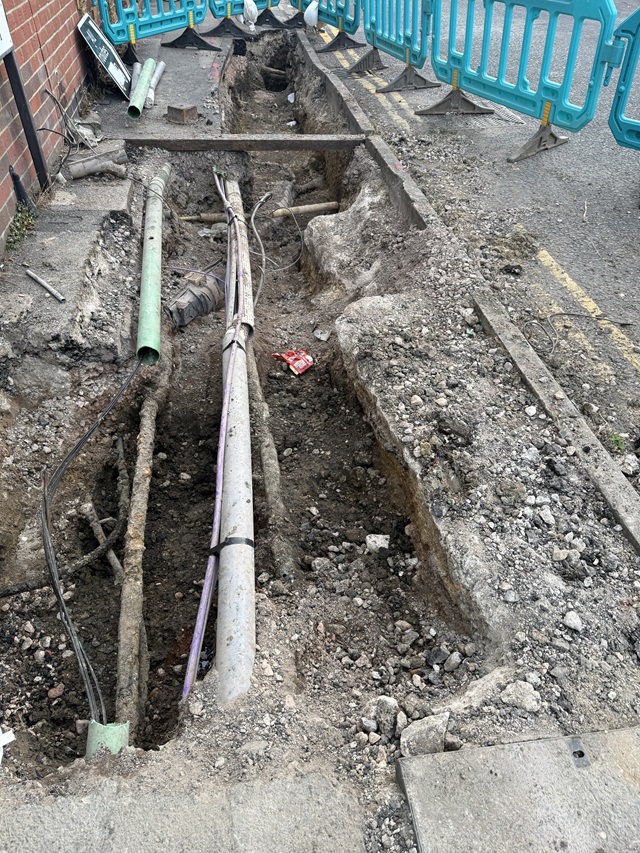
By coincidence electrical contractors are working in the street near me. They have dug a trench in the pavement and having seen the maze of stuff hidden below, I am not surprised services get damaged.
They spent most of yesterday gathering up the loose purple cables feeding Cityfibre to those that have it and bundling them neatly to an existing pipe.
| Re: Bombs, Bridge Strikes, Fires and Gas Main leaks Posted by ray951 at 13:19, 23rd September 2026 | |
The gas leak in Didcot is close to where I live, so I went to take a look this morning to see if I could try and understand why the railway remains closed.
The line has now been shut for more than 20 hours, yet people are able to walk and drive past the site without restriction. There have been no evacuations of nearby buildings and there is no longer any noticeable smell of escaping gas. Given that, I'm struggling to understand why the railway remains closed. If cars and lorries can safely pass the location, it seems reasonable to ask why, at the very least, diesel trains cannot do the same.
The leak was first reported yesterday afternoon, several hours before train services were suspended, so I find it difficult to believe that, at the very least, the gas supply has not been isolated.
SGN (Southern Gas Networks) requested the railway closure. Does anyone know whether they are required to compensate Network Rail for the disruption caused? More generally, are SGN and similar utilities being overly risk-averse, or is there simply insufficient incentive for them to restore normal operations as quickly as possible?
As an example of how incentives can work, there was another gas leak on a major road in Didcot last week. SGN initially maintained that the road would need to remain closed for more than a week, much to the frustration of local residents. However, once Oxfordshire County Council indicated that penalties of £8,000 per day could be imposed, the roadworks magically disappeared.
