









| long term future for overhead wires? Posted by infoman at 05:20, 23rd May 2026 |     |
Not sure if there are any plans for overhead Electrification in the West region.
Maybe
Stapleton road bank
Chippenham to Bristol
Cardiff to Swansea(possible on to LLanelli and Carmarthen
Although over head wires never look pleasant,especially in pretty view areas
Three places in this neck of the woods I would never like to see overhead wires is St Ives Newquay and Falmouth
with the Severn Beach line and Portishead lines.
Just wondering if the scheme on the Greenford branch could be introduced with underneath charging points at the the terminating station on the five routes mentioned.
| Re: long term future for overhead wires? Posted by grahame at 07:09, 23rd May 2026 | |
As I read it, it's all on "stop" at the moment - no money and no concrete plans to resume. Personal view - it is seen as more important to get people from Acton to Solihull as quickly as possible in 10 years time than it is to complete jobs which in some cases were already started. But yet with advancing technology, that just might make sense.
Works started and - would you describe them as abandoned? - at Thingley Junction.
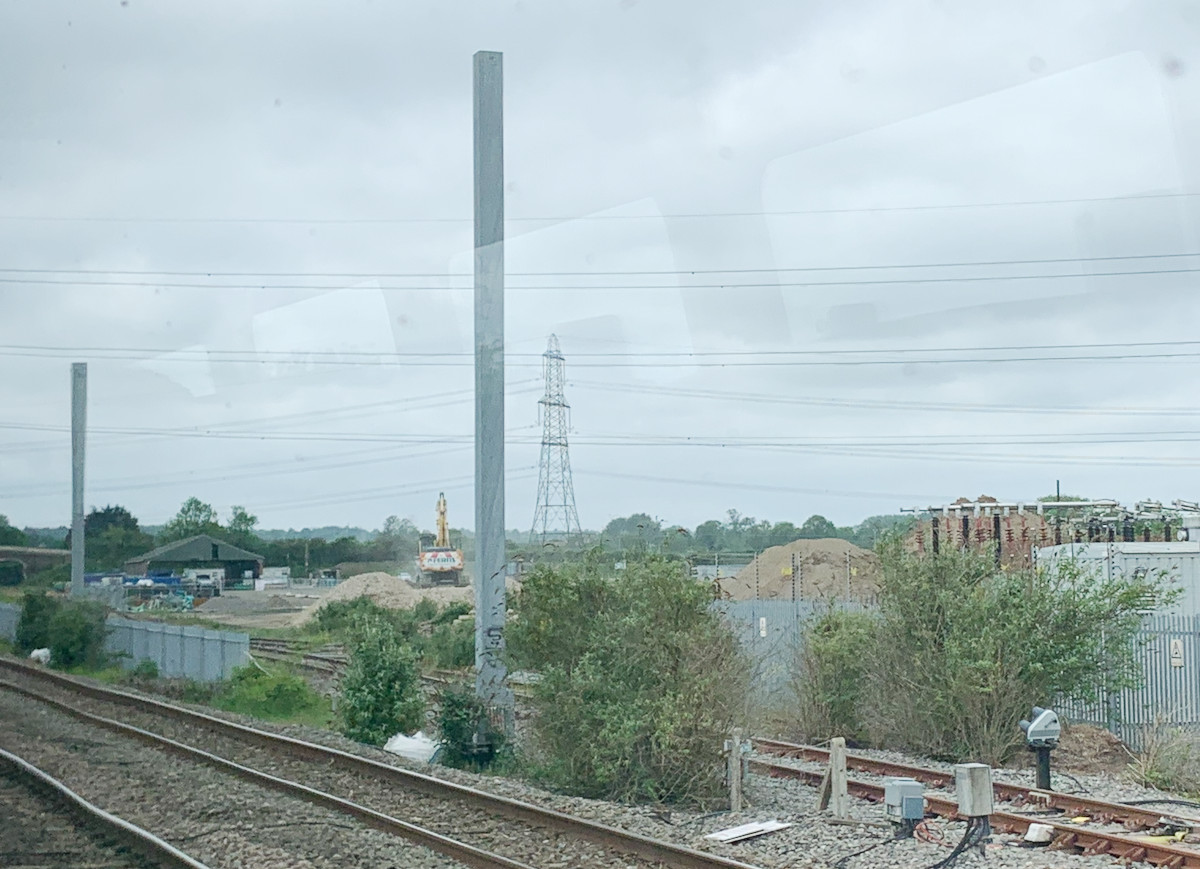
Personal view - from my armchair - would be the Didcot to Oxford and Cocklebury Lane and Parkway to Temple Meads would be the next sensible steps. So many services would then be able to go pure electric; does not cut the need for power (moves it away from the train) but at least it can be sustainable and not fossil, trains last longer, have better performances curves, and can still electrically do London - Cardiff even when Badminton is closed for engineering or flooding.
Also makes sense for freight to get electric to Westbury and the quarries - via Pewsey and via Melksham - nd that brings in more electric passenger trains too.
| Re: long term future for overhead wires? Posted by John D at 08:11, 23rd May 2026 | |
It's coming up to 9 years since Grayling killed parts of Great Western electrification (it was July 2017)
As photographed above there are a number of masts west of Chippenham doing nothing. I think about third of the mast bases and a few masts were also installed Didcot - Oxford.
Things have moved on with cost control, and the stupidity of not resuming it once costs were controlled has never really made sense as a long term strategy (and even less so in new era of high diesel prices).
Ironically the delay to ordering replacements for 158,159,165,166,168 diesel fleet might benefit a few electrified sections, if it means battery charging is possible, and don't have to fit diesel engines (which require servicing and maintenance of the engines). There is obviously a cost implication of adding diesel generators to replacement fleet (plus ongoing extra operational costs), which could be used to pay for some of the electrification instead.
But doing joined up thinking, or any form of mid or longer term planning seems to be beyond current batch of ministers, who seem to be more into short term thinking and regular U turns
| Re: long term future for overhead wires? Posted by TaplowGreen at 08:13, 23rd May 2026 | |
It's coming up to 9 years since Grayling killed parts of Great Western electrification (it was July 2017)
As photographed above there are a number of masts west of Chippenham doing nothing. I think about third of the mast bases and a few masts were also installed Didcot - Oxford.
Things have moved on with cost control, and the stupidity of not resuming it once costs were controlled has never really made sense as a long term strategy (and even less so in new era of high diesel prices).
Ironically the delay to ordering replacements for 158,159,165,166,168 diesel fleet might benefit a few electrified sections, if it means battery charging is possible, and don't have to fit diesel engines (which require servicing and maintenance of the engines). There is obviously a cost implication of adding diesel generators to replacement fleet (plus ongoing extra operational costs), which could be used to pay for some of the electrification instead.
But doing joined up thinking, or any form of mid or longer term planning seems to be beyond current batch of ministers, who seem to be more into short term thinking and regular U turns
As photographed above there are a number of masts west of Chippenham doing nothing. I think about third of the mast bases and a few masts were also installed Didcot - Oxford.
Things have moved on with cost control, and the stupidity of not resuming it once costs were controlled has never really made sense as a long term strategy (and even less so in new era of high diesel prices).
Ironically the delay to ordering replacements for 158,159,165,166,168 diesel fleet might benefit a few electrified sections, if it means battery charging is possible, and don't have to fit diesel engines (which require servicing and maintenance of the engines). There is obviously a cost implication of adding diesel generators to replacement fleet (plus ongoing extra operational costs), which could be used to pay for some of the electrification instead.
But doing joined up thinking, or any form of mid or longer term planning seems to be beyond current batch of ministers, who seem to be more into short term thinking and regular U turns
Why was it stopped? Was it way behind schedule and/or over budget?
| Re: long term future for overhead wires? Posted by John D at 08:24, 23rd May 2026 | |
It's coming up to 9 years since Grayling killed parts of Great Western electrification (it was July 2017)
As photographed above there are a number of masts west of Chippenham doing nothing. I think about third of the mast bases and a few masts were also installed Didcot - Oxford.
Things have moved on with cost control, and the stupidity of not resuming it once costs were controlled has never really made sense as a long term strategy (and even less so in new era of high diesel prices).
Ironically the delay to ordering replacements for 158,159,165,166,168 diesel fleet might benefit a few electrified sections, if it means battery charging is possible, and don't have to fit diesel engines (which require servicing and maintenance of the engines). There is obviously a cost implication of adding diesel generators to replacement fleet (plus ongoing extra operational costs), which could be used to pay for some of the electrification instead.
But doing joined up thinking, or any form of mid or longer term planning seems to be beyond current batch of ministers, who seem to be more into short term thinking and regular U turns
As photographed above there are a number of masts west of Chippenham doing nothing. I think about third of the mast bases and a few masts were also installed Didcot - Oxford.
Things have moved on with cost control, and the stupidity of not resuming it once costs were controlled has never really made sense as a long term strategy (and even less so in new era of high diesel prices).
Ironically the delay to ordering replacements for 158,159,165,166,168 diesel fleet might benefit a few electrified sections, if it means battery charging is possible, and don't have to fit diesel engines (which require servicing and maintenance of the engines). There is obviously a cost implication of adding diesel generators to replacement fleet (plus ongoing extra operational costs), which could be used to pay for some of the electrification instead.
But doing joined up thinking, or any form of mid or longer term planning seems to be beyond current batch of ministers, who seem to be more into short term thinking and regular U turns
Why was it stopped? Was it way behind schedule and/or over budget?
Was going seriously over budget, (and behind schedule) and instead of saying pause and refocus, just took axe to it. Ignored the ongoing alternative costs it created.
It was a time when skills were being outsourced to consultants, so something like a drain cover where a mast was planned, meant leaving it, getting consultants out again, redesigning, expensively coming back later with electrification train. Rather than having skilled and empowered staff doing simple tweak to plan there and then.
The structure at the time was not incentivised to get it finished as efficiently as possible, but was more like see what extra work and revenue can get from it. HS2 contracts were devised in same cost plus era too.
